Electrical Switch Repair Singapore: Warning Signs, Safety and Next Steps
A switch can still turn on a light and yet show signs of a problem. If it feels unusually hot, crackles, flickers, or stops working, the cause could be the switch, the light fitting, or the circuit. This guide to electrical switch repair Singapore residents may need explains what to look for, what you can safely observe, and when to arrange a professional assessment.
These symptoms don’t all point to the same fault. A failed bulb or a wider circuit issue can look like a switch problem. Stop using a switch that feels hot, sparks, or makes unusual sounds. Don’t open it or touch its wiring.
You’ll learn which signs need attention, what you can check without handling electrical parts, and what information to share when arranging repair. A technician can assess the switch and related components before advising on repair or replacement. Sar Deen Engineering Pte Ltd provides residential power socket and switch repair across Singapore, helping you take a practical next step.
Key Takeaways
- Heat, a burning smell, sparks, or crackling are warning signs. Stop using the switch and don’t open it or handle its wiring.
- A flickering or failed light doesn’t always indicate a faulty switch. Note whether the problem affects one light or several.
- For electrical switch repair Singapore, a technician can assess the reported symptoms and the switch’s condition before considering repair or replacement.
- Before arranging help, note what happens, when it happens, and any visible damage. Don’t keep testing a switch that feels hot or appears unsafe.
- Sar Deen Engineering provides residential power socket and switch repair across Singapore. Share the symptoms when enquiring to give the issue a clear starting point.
Electrical switch repair Singapore: warning signs you should not ignore
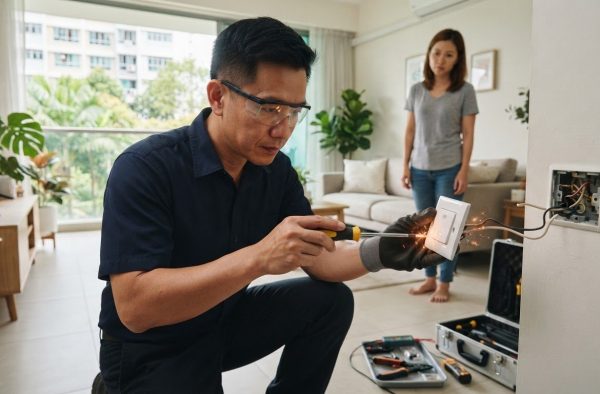
Heat, a burning smell, sparks, or crackling from a switch deserve prompt attention. Stop using a switch that feels unusually hot or looks damaged, and arrange a professional assessment. These signs may indicate an electrical fault, but they don’t reveal its exact cause. Don’t open the switch or touch exposed wiring.
Pay attention to how the switch changes, rather than trying to diagnose it. A switch that feels slightly warm after use is different from one that is unusually hot, discoloured, or giving off a burnt smell. Don’t repeatedly operate a switch to confirm a suspected fault.
Which electrical switch symptoms need prompt attention?
Look and listen for changes without touching the switch. Sparks, crackling, visible damage, unusual heat, or a burning odour are reasons to stop using it and seek professional help. Note what you observed, but don’t treat one symptom as proof of a particular fault. Never dismantle the switch or handle exposed wiring.
- Unusual heat: The switch feels distinctly hot rather than mildly warm.
- Burning smell or discolouration: You notice a burnt odour, scorch mark, or change in the switch’s appearance.
- Sparks or crackling: You see a flash or hear a crackling sound when the switch is operated.
- Visible damage: The switch plate is cracked, broken, or appears loose.
These observations are useful to report, not reasons to investigate inside the switch. Electrical switches vary in form and function, as outlined in Understanding Electrical Switches. If a switch gives cause for concern, leave it alone and have it assessed.
When a switch does not work as expected
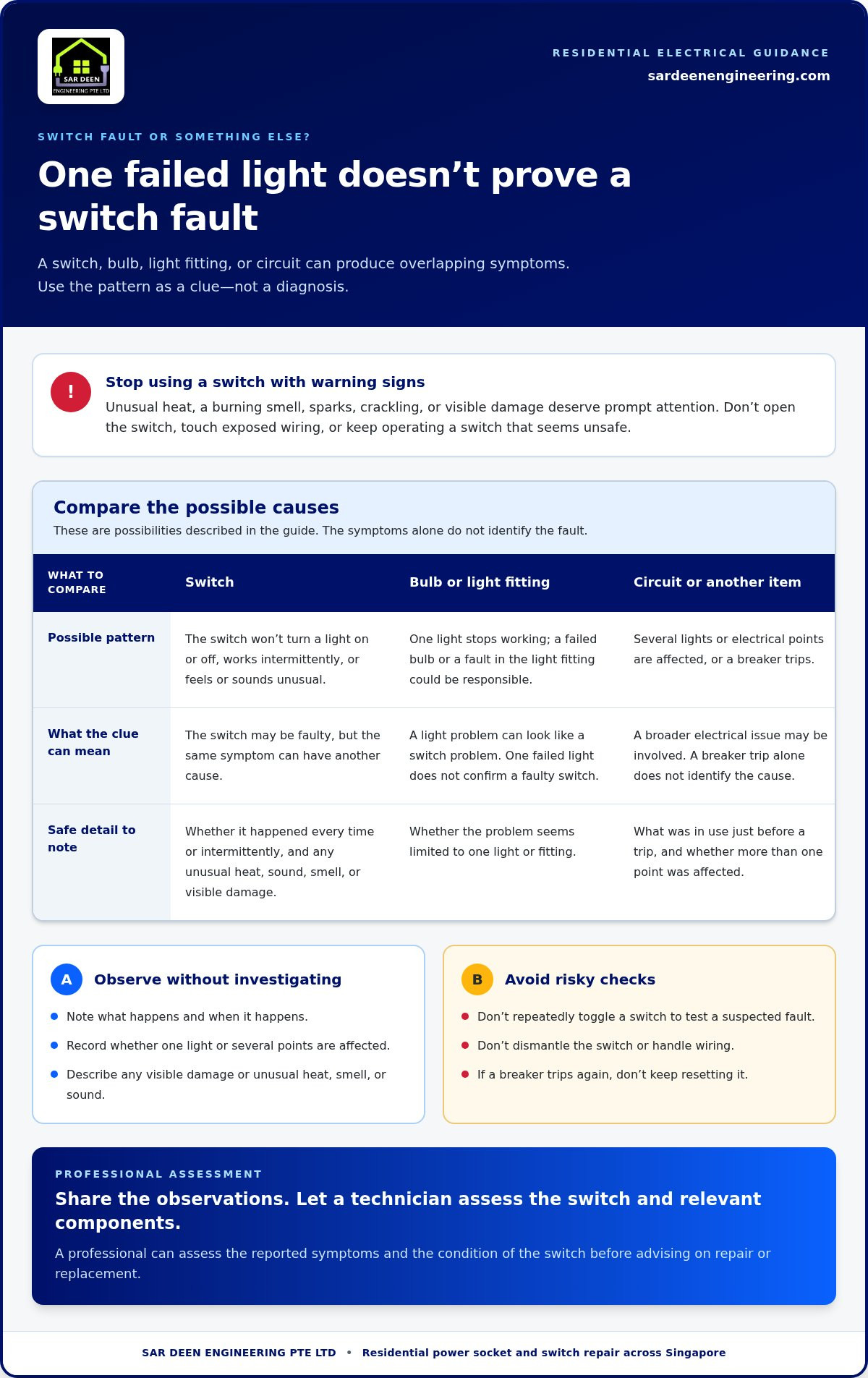
A switch that won’t turn a light on or off, or works only intermittently, may be faulty. But a bulb, light fitting, or circuit issue can cause similar symptoms. One failed light doesn’t confirm that the switch is the problem. A technician may need to assess the relevant components to identify the cause.
Note the pattern without repeatedly testing the switch. Record whether the problem affects one light or several, whether it happens every time, and whether the switch feels or sounds unusual. Don’t force a stiff switch or keep toggling one that behaves inconsistently. These observations help guide an assessment without requiring you to diagnose or repair electrical parts.
For electrical switch repair Singapore, start by describing what happened. Stop using the switch if it’s hot, visibly damaged, sparking, or making unusual sounds. Clear observations can help distinguish a possible switch fault from an issue elsewhere, while a professional handles the technical checks.
Is the electrical switch faulty or is the issue elsewhere?
A light that won’t turn on doesn’t automatically mean its switch has failed. The cause could be the switch, the bulb, the light fitting, or the circuit. Since symptoms can overlap, treat them as clues rather than a diagnosis. A professional may need to inspect the switch and relevant parts of the electrical installation.
Why a light that stays off may not mean a broken switch
If one light stops working, a failed bulb or a fault in the light fitting could be responsible. If other lights or electrical points are affected too, the issue may involve a circuit rather than one switch. These are possibilities, not conclusions. Don’t remove the switch plate to investigate or handle wiring. If the problem persists, arrange a professional assessment.
For a clearer account, note what works and what doesn’t. Does the switch move normally? Has the light stopped working entirely, or does it behave inconsistently? Is the problem limited to one fitting? Don’t repeatedly operate the switch to test a theory, and don’t dismantle electrical parts. These details can help a technician decide what to inspect.
What repeated breaker trips can indicate
A tripping breaker can point to an electrical issue beyond the switch. The switch, light fitting, circuit, or another connected electrical item may be relevant, but the trip alone doesn’t identify the cause. If the breaker trips again, don’t keep resetting it to restore power. Leave troubleshooting to a professional, especially if you also notice heat, sparks, a burning smell, or unusual sounds.
Before arranging an assessment, record what was in use just before the trip. Note whether you were operating a particular light switch or using another electrical item, and whether the trip happened once or returned. This is more useful than guessing which component has failed. Keep the account factual: what was on, what stopped working, and what you noticed.
Consider whether the symptom seems local or affects more than one point. One light staying off may involve its bulb or fitting. Several affected points or a breaker trip may call for a broader inspection. Neither pattern proves the cause. A technician can assess the relevant components and electrical installation before recommending what should happen next.
For practical guidance on household electrical work, the electrical services guide for homeowners offers helpful context. If you’re unsure whether the problem involves a switch or another part of the installation, arrange residential electrical switch repair with Sar Deen Engineering and describe what you observed. That gives the assessment a clear starting point without requiring you to diagnose or handle electrical parts yourself.
Electrical switch repair or replacement: how to understand the options
A fault doesn’t automatically mean a switch needs replacing. First, a technician can assess the symptoms, the switch’s condition, and the connected circuit. That assessment helps determine whether repair is suitable or replacement should be considered. One symptom, such as a light failing to turn on, isn’t enough to decide.
The table below shows how reported symptoms may guide an assessment. These are possibilities, not diagnoses or fixed outcomes.
| Reported symptom | Possible repair assessment | When replacement may be considered |
|---|---|---|
| Switch feels loose or works inconsistently | Check its operation and the relevant connections | If the switch is damaged or continues to fail |
| Visible cracks or other damage | Assess the switch’s condition and whether it can be safely repaired | If the damage affects its safe or reliable operation |
| Light doesn’t respond to the switch | Consider the switch alongside the light fitting, bulb, and circuit | If assessment identifies a switch fault that isn’t suitable for repair |
| Switch makes unusual sounds | Inspect the switch and associated electrical components | If the switch is damaged or the fault persists |
When might repair or replacement be considered?
Repair may be an option if assessment finds a fault that can be addressed and the switch remains in suitable condition. Replacement may be considered if the switch is visibly damaged, in poor condition, or the problem keeps returning. None of these signs alone proves replacement is necessary. The decision depends on what the assessment finds and whether the existing switch can operate reliably.
Does the type of switch change the assessment?
Yes. A basic light switch, dimmer, two-way switch, or water heater switch may be connected to a different setup, so the checks and work can vary. Smart switches are another category, with requirements that depend on the installation. The switch type and connected circuit matter; one repair approach won’t suit every situation.
When describing the issue, name the switch’s purpose if you know it. For example, say whether it controls a light from one point, a light from two locations, or a water heater. You don’t need to identify the wiring or open the switch. A clear description helps the technician understand what to assess before discussing the options.
For residential electrical switch repair Singapore, Sar Deen Engineering provides power socket and switch repair across Singapore. Share what the switch controls, what it’s doing, and whether you’ve noticed visible damage. This gives the assessment a practical starting point, while the switch and circuit condition guide whether repair or replacement is appropriate. Arrange residential switch repair if you need help with the next step.
Before arranging electrical switch repair in Singapore
A few clear observations can help you explain the problem and give a technician a place to begin. You don’t need to identify the fault or test electrical parts. Note what you noticed, when it started, and what was operating at the time. If the switch is hot, damaged, sparking, or smells burnt, stop using it and keep clear.
What information helps explain the switch problem?
Describe the affected switch by its location and what it normally controls, such as a bedroom light or water heater. Focus on the pattern you’ve noticed, not a guess about the cause. If it’s safe to approach, you may take a photo from a distance that shows visible damage without touching the switch or fitting.
- Location and purpose: Identify the room and what the switch controls.
- Timing: Note when the issue began and whether it happens every time or intermittently.
- What was operating: Record which lights or electrical items were in use when the symptom occurred.
- Observed signs: Describe any sound, unusual heat, visible damage, or breaker trip.
- Photo, if safe: Take one from a safe distance only if approaching the area presents no risk.
Keep your description factual. “The switch made a crackling sound when I used it” is more helpful than deciding it’s faulty. If a breaker tripped, note what was on beforehand and whether it has happened more than once. These details give a professional a useful starting point without asking you to investigate the wiring.
What should you avoid before professional assessment?
Leave electrical checks and repair work to a professional. Don’t remove the faceplate, touch exposed wiring, or try to tighten or replace parts. Avoid repeatedly operating a switch that shows warning signs. If a breaker trips again after being reset, don’t keep resetting it. Record what happened and arrange an assessment instead.
- Don’t dismantle the switch or put tools near it.
- Don’t use a hot, damaged, sparking, or burnt-smelling switch.
- Don’t repeatedly reset a breaker when the problem returns.
- Don’t approach the fitting to take a photo if it seems unsafe.
For broader home upkeep, the Singapore home maintenance checklist can help put electrical concerns in context alongside other household maintenance. For electrical switch repair Singapore, share your observations with Sar Deen Engineering when arranging residential power socket and switch repair. Enquire about switch repair and describe the location, symptoms, and any breaker trips you’ve noticed.
Arrange residential electrical switch repair with Sar Deen Engineering
Once you’ve noted what the switch is doing, arrange professional help rather than attempting a repair yourself. Sar Deen Engineering provides residential power socket and switch repair across Singapore. Share the symptoms you observed so your enquiry explains the issue clearly.
What to expect when enquiring about switch repair
Keep your description simple and specific. Identify where the switch is and what it controls, then explain what you noticed and when it happens. For example: “The living room light switch has worked inconsistently since yesterday.” This gives useful context without requiring you to identify the cause, open the fitting, or suggest a repair method.
- Identify the switch: Name its location and what it normally controls.
- Describe the symptom: Say whether it fails, works intermittently, feels unusually hot, or makes a sound.
- Add relevant context: Mention when the issue began and whether a breaker tripped.
- State any safety concern: Be clear if you noticed sparks, visible damage, or a burnt smell.
Stick to what you saw, heard, or experienced. You don’t need to test the switch again to improve your description. If it shows a warning sign, leave it unused and mention that when enquiring. This keeps the request focused on the switch problem rather than guesses or DIY repair instructions.
When a switch issue is part of wider home maintenance
A switch is one part of a home’s electrical setup, and a symptom can sometimes involve another part of the installation. Sar Deen Engineering provides residential electrical solutions across Singapore, including power socket and switch repair. Keep your enquiry focused on the affected switch and its symptoms. A clear account is a practical starting point without presuming what work will be needed.
You don’t need technical language or a diagnosis to explain the problem. A concise description of the location, what the switch controls, and how it behaves is enough to communicate your concern. The appropriate repair depends on the issue, so avoid assuming the work or outcome before assessment.
If the switch is hot, damaged, sparking, or smells burnt, don’t continue using it while arranging help. Otherwise, describe the symptoms when making your enquiry. For electrical switch repair Singapore residents can arrange residential electrical assistance with Sar Deen Engineering. Enquire about residential switch repair and describe what you’ve noticed.
Take the next step with confidence
A switch problem doesn’t need to become a guessing game. Treat your observations as a starting point, then let a professional assessment guide the decision. This keeps the focus on the switch’s actual condition rather than assumptions about the fault or the fix.
If you’re ready to move forward, Sar Deen Engineering provides residential electrical switch repair Singapore homeowners may need. Share what you’ve noticed and where the switch is located. You don’t need to diagnose the issue before enquiring.
Arrange residential electrical switch repair with Sar Deen Engineering and describe the issue so it can be assessed. A straightforward account is enough to begin.
Frequently Asked Questions
How much does electrical switch repair cost in Singapore?
Electrical switch repair Singapore costs vary with the switch type and what an assessment finds. A straightforward issue may require different work from a fault involving the connected circuit or another component. Describe the symptoms and the switch’s purpose when enquiring, and ask about applicable pricing before proceeding. Online estimates may not reflect the work your home needs.
Can a faulty electrical switch affect other lights in the home?
It can, depending on how the switches and lights are connected. One switch may control several lights, or lights may share part of an electrical circuit. If more than one light behaves unusually, note which ones are affected and whether they respond to the same switch. This pattern is useful context, but it doesn’t confirm the cause.
Is it safe to use a switch that feels warm?
If a switch feels unusually hot, don’t keep using it. Leave it alone and arrange a professional assessment. Avoid repeatedly touching the faceplate to judge its temperature, and don’t open the switch to inspect the wiring. If you also notice a burning smell, sparks, or visible damage, mention those signs when describing the problem.
Can an electrician repair a dimmer or two-way switch?
A dimmer or two-way switch can be assessed for repair, but suitable work depends on its condition and the connected setup. A dimmer controls light output, while a two-way arrangement lets a light be controlled from separate points. Describe how the switch is used and what has changed. Don’t remove it to identify its wiring or parts.
What information should I provide when arranging switch repair?
Give the switch’s location, what it controls, and a short account of the problem. For example: “The hallway light’s two-way switch stopped responding from one side.” Add when you first noticed the change and whether other lights are affected. Share a photo only if it was taken safely, without approaching or touching a concerning fitting.
Does a switch that trips the breaker always need replacing?
No. A breaker trip doesn’t show by itself that the switch needs replacement. The issue could involve the switch, another connected component, or the circuit. A professional assessment can help identify what needs attention. If the breaker trips again, don’t keep resetting it to test the switch. Note what was operating beforehand and include that detail in your enquiry.
Can a switch be repaired without replacing its faceplate?
Possibly. The faceplate and switch mechanism are separate parts, so an intact faceplate may not need replacing if the fault is elsewhere. A technician needs to assess the switch and its condition to determine the appropriate work. Don’t remove the plate yourself to check what’s behind it, even if it looks undamaged.