Flat Pack Furniture Assembly Singapore: A Step-by-Step Guide
What if the first sign of a furniture assembly mistake only appears when the finished piece starts to wobble? A sturdy result depends less on speed than on following the right sequence and keeping each part aligned. Whether you’re building it yourself or considering flat pack furniture assembly Singapore options, a little preparation can help prevent loose fittings, damaged panels and a frustrating do-over.
Confusing instructions, similar-looking hardware and limited room to work can make a straightforward build feel tricky. It’s easy to overtighten a screw or move on before checking that the frame is square. Take your time, and check each step before proceeding.
This guide explains how to prepare your space, sort the parts and tools, follow the manual, and check the finished furniture for stability and alignment. You’ll also learn when a larger or more complex build may be easier with professional help. Sar Deen Engineering Pte Ltd provides furniture assembly in Singapore for those who prefer support with the job.
Key Takeaways
- Read the full manual and check the parts and hardware against the inventory before you begin.
- Follow the manufacturer’s assembly sequence, and confirm each panel’s orientation before tightening connections.
- Use signs such as uneven doors or wobbling to spot possible alignment or assembly errors.
- Inspect the finished item before use, and follow its instructions when deciding whether and how to anchor it to a wall.
- For flat pack furniture assembly Singapore, consider professional help if the build is complex, difficult to handle, or beyond your time or confidence.
Before assembling flat-pack furniture in Singapore, prepare the space and parts
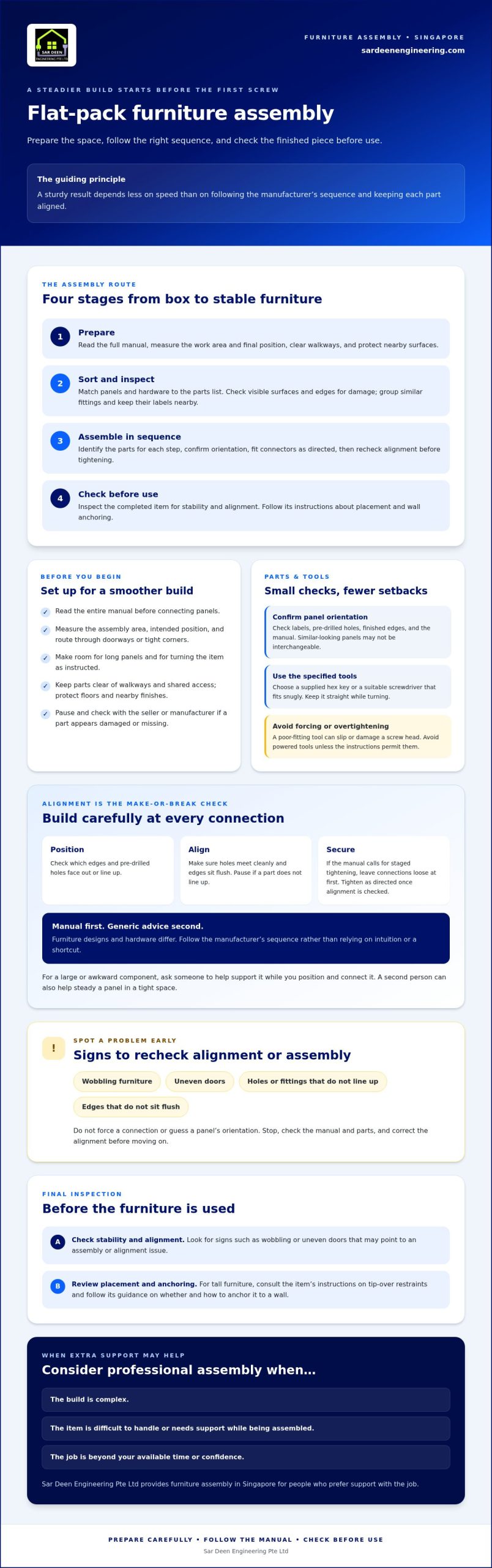
A stable build starts before you connect the first panel. Read the entire manual first. This helps you understand the order, spot steps that may need another person, and see whether a later part must be fitted before an earlier one is tightened. Skipping ahead can mean undoing connections, which may damage panels or fittings.
Flat-pack furniture, also known as Ready-to-assemble furniture (RTA), arrives with components intended to be put together at home. Each kit has its own sequence, labels and hardware, so follow the manufacturer’s manual rather than relying on intuition. Preparation is especially useful when working in a limited space.
What should you check before starting a flat-pack build?
Lay out the parts where you can see them, then compare each panel and fitting with the manual’s parts list. Check visible surfaces and edges for dents, cracks or other transit damage before joining anything. Group similar-looking screws, dowels and fittings separately, and keep their labels or manual references nearby. If a part appears damaged or missing, pause and check with the seller or manufacturer before proceeding.
Don’t assume that two panels with similar shapes are interchangeable. Check labels, pre-drilled holes and finished edges, then confirm the panel’s purpose in the instructions. This can prevent a panel being fitted backwards or a connection being made in the wrong place.
How do you prepare a Singapore home for furniture assembly?
Measure both the assembly area and the furniture’s intended position before opening the package. Allow enough room to lay out long panels and turn the item as the instructions require. Check the route to its final position too, including doorways and tight corners. In a compact home or shared living space, plan where parts can sit without blocking walkways or shared access.
Protect the floor and nearby finishes with a suitable covering, and keep small fittings together so they’re easy to find. Choose a work area close enough to the final position to reduce unnecessary handling, while leaving room to follow each step safely.
Preparation checklist: Read the full manual, measure the work area and final position, clear walkways, protect nearby surfaces, and check every panel and fitting against the parts list.
How to assemble flat-pack furniture step by step
Follow the sequence in the kit’s manual from start to finish. Furniture designs differ, so a shortcut that works for one item may leave another out of square or with a fitting in the wrong place. The manufacturer’s manual takes priority over generic assembly advice.
Use this general sequence to stay organised, not as a replacement for the instructions:
- Identify the panels and fittings needed for the current step.
- Check each panel’s orientation, including which edges and pre-drilled holes face out or line up.
- Fit the specified connectors in the order shown, keeping them loose at first if the manual calls for staged tightening.
- Recheck alignment, then tighten as directed before moving on to the next part.
- Ask someone to help support large or awkward components while you position and connect them.
Pause if a hole, edge or fitting doesn’t line up. Don’t force parts together or assume a panel is facing the right way because it looks similar to another. When working in a tight space, a second person can help steady a large panel and reduce the chance of it shifting during assembly.
Which tools do you need for flat-pack furniture assembly?
Start with the tools named in the specific manual. Use a supplied hex key or a suitable screwdriver that fits the fastener snugly, and keep the tool straight as you turn it. A poor fit can slip, mark the surface or damage the screw head. Avoid powered tools unless the instructions permit them, since they can make it easier to overtighten a connection.
How do you keep panels square and connections aligned?
Where the instructions call for staged tightening, fit connections loosely first so the panels can settle into position. Check that holes meet cleanly and edges sit flush before securing each joint. Tighten carefully, stopping when the connection is secure rather than applying extra force. This helps protect panels, threads and visible finishes. For tall furniture, consult the item’s instructions on tip-over restraints. The U.S. Consumer Product Safety Commission also offers flat-pack furniture stability guidance.
If the instructions are unclear or a component is difficult to handle, pause rather than guessing. Sar Deen Engineering Pte Ltd provides furniture assembly in Singapore. Learn more about professional furniture assembly.
Common flat-pack assembly mistakes, and how to fix them
Not every flat-pack kit can be assembled by feel. Panels may look alike but have different hole positions, and fittings that seem interchangeable may not be. Skipping the manual or guessing the next step can leave doors uneven, joints loose or the whole item unstable. A small alignment error can become harder to correct once several panels are connected.
If something looks wrong, stop and check before applying force. Compare the part’s label and orientation with the diagram, then review the recent steps. A connection that won’t meet cleanly may mean a panel is fitted backwards, a connector is in the wrong hole, or an earlier joint was tightened too soon. Forcing it can damage the panel or fitting and make the correction more difficult.
Why is flat-pack furniture wobbly after assembly?
Start by checking that panels and braces are fitted in the orientation shown in the manual. Confirm that connectors are seated correctly and tightened as directed. Then place the item on an even surface and follow any adjustment steps provided. A wobble may come from an assembly issue, but check whether the floor is uneven before changing the furniture or its fittings.
Uneven doors can also signal that the frame is not square or that a panel or hinge is misaligned. Revisit the relevant assembly steps and adjust only as the manufacturer instructs. Don’t compensate by overtightening one fitting. Excess force may damage the connection without correcting the underlying alignment.
What should you do if parts or instructions are missing?
Pause the build. Compare what you have with the manual’s parts list, and check the packaging for small fittings that may have shifted or been overlooked. Don’t substitute a screw or connector just because it appears to fit. A different fitting may not secure the joint properly or could damage the material.
If a component is missing or visibly damaged, separate it from the parts you’re using and contact the furniture supplier. Ask them to confirm the correct replacement part or provide the relevant instructions before continuing. A reversed panel or loose connector may be fixable by following the manual, but a damaged or unverified component needs supplier guidance.
If the manual remains unclear or the parts are difficult to handle safely, stop rather than guessing. Professional furniture assembly is an option when troubleshooting no longer feels straightforward.
Check flat-pack furniture stability and placement before use
Before loading shelves or using a newly assembled item, inspect it in place. A final check can reveal a loose fitting, an uneven base or a door that needs adjustment. Follow the manufacturer’s final inspection steps, since the correct checks vary by furniture type.
How can you tell whether assembled furniture is stable?
Start with the item on the floor where you plan to use it. Check that it sits evenly and doesn’t rock. Inspect visible joints and fittings against the manual, and look for gaps or connections that appear loose. Gently test doors, drawers and other moving parts. They should move as intended without the frame shifting or catching.
Don’t load shelves or place heavy items inside until the checks are complete. If the furniture rocks, first confirm that it’s on an even surface. Then review the manual for adjustment steps. Avoid improvised packing or forceful tightening, which may hide the cause rather than correct it.
When should flat-pack furniture be anchored to a wall?
Check the specific item’s instructions for anti-tip guidance. Whether and how to anchor furniture depends on those directions, the wall material and the suitability of the fixing. Don’t assume that a fixing supplied with the item will suit every wall. If you’re unsure what the wall is made of, which fixing is appropriate, or how to install it safely, seek suitable help before drilling.
Placement matters too. Keep household walkways clear, especially if the item has doors or drawers that open into a shared path. Choose a position where the furniture can be used as intended without obstructing movement. Recheck its stability after moving it into place.
Before use, confirm the furniture sits evenly, joints and fasteners match the manual’s final checks, and moving parts work smoothly. Follow the item’s guidance on wall anchoring.
A careful final inspection helps catch issues before furniture is put to everyday use. If handling the item or checking its assembly feels difficult, Sar Deen Engineering Pte Ltd provides furniture assembly in Singapore. Ask about furniture assembly if you’d prefer professional help.
When to choose professional flat-pack furniture assembly in Singapore
DIY assembly can work well when the item is manageable, the instructions are clear and you have enough time to follow them carefully. Professional help may make more sense if the build is complex, the components are difficult to handle, or you’re unsure how to resolve repeated alignment problems. Consider the furniture’s size, the manual, your available time and your confidence before deciding.
Which flat-pack assembly jobs are harder to manage alone?
Tall, bulky or multi-part furniture can be awkward to position, especially in a compact room. A second person may be needed to support large components while they’re joined. Pause if diagrams are unclear, parts keep failing to align, or continuing could damage the furniture or make handling unsafe. Don’t force a connection just to finish the build. For a bulky item such as a wardrobe, this guide to wardrobe assembly Singapore covers room planning and how to get a stable, well-fitted result.
Time matters too. If you can’t set aside enough time to work through the instructions without rushing, getting help may be a practical option. Sar Deen Engineering Pte Ltd provides furniture assembly in Singapore. For readers comparing options, the furniture assembly service guide explains what to consider when choosing a service and what to expect.
What information should you prepare when requesting assembly help?
Share the furniture type and, if available, its manufacturer and model details. Explain whether the package is already at home, where you intend to place the item, and whether assembly has already started. Mention any missing or damaged components, unclear instructions or parts that are difficult to handle. These details help the provider understand the job and clarify what preparation may be needed.
Before confirming, ask what the service includes and whether you need to clear the work area, keep the manual accessible or have all parts unpacked. Confirm any details that matter to your situation rather than assuming they’re covered.
You can assemble simpler items yourself and get help for a more demanding build. If you’d like support with furniture assembly, contact Sar Deen Engineering Pte Ltd to discuss your needs.
Build with care for a steadier finish
A reliable flat-pack build starts with preparation. Read the manual, check the parts, and follow the maker’s sequence instead of guessing. As you assemble, confirm panel orientation and alignment before tightening connections. Then inspect the finished item for wobble, loose fittings and correct placement before using it.
The right approach also depends on the item and your space. If a build is bulky, instructions are unclear, or handling it safely feels difficult, pause and ask for help to avoid preventable damage.
Sar Deen Engineering provides furniture assembly as part of its residential home maintenance and installation services. If you’d like support with your build, ask Sar Deen Engineering about professional furniture assembly.
Take it step by step, and you’ll be better prepared for a stable, well-fitted result.
Frequently Asked Questions
How do you assemble flat-pack furniture?
Assemble flat-pack furniture by following the manufacturer’s instructions in order. Read the manual, identify each panel and fitting, and check panel orientation before connecting parts. Fit components as directed, keeping connections loose if the instructions call for staged tightening. Check alignment before securing each joint, and don’t force parts that don’t line up. Allow enough room to work and move the finished item into place.
What tools do I need to assemble flat-pack furniture?
Use the tools listed in the furniture’s instructions. Many kits include a hex key, while some steps may call for a suitable screwdriver. Choose a tool that fits the fastener properly and turn it carefully to avoid slipping or damaging the finish. Don’t use powered tools unless the manufacturer permits them, since excess force can damage panels or fittings. Keep the manual nearby so you can check the tool requirements as you work.
Why is my flat-pack furniture wobbly after assembly?
Wobbling may mean a panel or brace is fitted in the wrong orientation, a connector isn’t seated correctly, or a joint hasn’t been tightened as instructed. Check the manual’s assembly and adjustment steps, then confirm the item is standing on an even surface. Don’t try to correct the problem by overtightening one fitting. If a part won’t align or appears damaged, stop and check the instructions or contact the furniture supplier.
Can one person assemble flat-pack furniture?
One person may be able to assemble a small, manageable item if the instructions allow it and there’s enough room to work safely. Larger, taller or awkwardly shaped components can be difficult to hold in position while making connections. A second person can help support these parts and reduce the chance of them shifting. If you’re unsure you can handle a component safely, pause and consider asking someone for help.
How long does flat-pack furniture assembly take?
Assembly time varies with the furniture’s size, number of parts, instructions and your familiarity with the process. A simple item may take less time than a multi-part build with several alignment steps. Check the manufacturer’s guidance if it gives an estimate, and allow extra time to sort parts, follow the manual and inspect the result. Avoid rushing to meet an assumed timeframe, since missed steps can lead to avoidable disassembly.
Should flat-pack furniture be secured to the wall?
Check the manufacturer’s instructions for anti-tip guidance for that specific item. Whether anchoring is appropriate depends on the furniture, wall material and use of compatible fixings. Don’t assume a supplied fixing suits every wall, and don’t drill if you’re unsure about the wall or installation. Seek suitable help if needed. Keep walkways clear when choosing the furniture’s position, and follow the manual’s placement and safety advice.
What should I do if a flat-pack furniture part is missing?
Pause assembly and compare the package contents with the manual’s parts list. Check the packaging for small fittings that may have shifted, but don’t substitute a similar-looking screw or connector without confirmation. Contact the furniture supplier to identify the correct replacement part or request missing instructions. Continuing with an unverified fitting may affect how securely the furniture connects. Resume the build only when you have the right part and clear guidance.