Storage Water Heater Installation Singapore: The 2026 Homeowner Buying Guide
A bigger hot water tank won’t solve your family’s morning shower rush if it cannot fit through your bathroom ceiling access opening. Executing a storage water heater installation Singapore homeowners can rely on requires balancing daily hot water volume, tight overhead clearance, and strict utility standards. It’s natural to feel stuck between choosing a 30-litre or 50-litre model, especially while worrying about hidden water leaks, electrical isolator switch requirements, or accidental ceiling damage.
You don’t have to gamble with your bathroom comfort. Discover how to accurately calculate the right water heater capacity for your household routines, identify durable tank materials, and ensure a safe, code-compliant setup by certified trade professionals. We walk you through essential false ceiling dimensions, safety valve rules, and PUB guidelines so you can choose and install your next unit with complete confidence.
Key Takeaways
- Calculate your household’s ideal litre capacity to maintain steady water pressure across multiple bathrooms without driving up power bills.
- Evaluate inner tank materials and high-density insulation to extend system lifespan and cut down on daily heat loss.
- Check false ceiling clearances and access panel dimensions early to prevent structural fit issues before purchasing a unit.
- Understand the critical PUB codes and electrical isolator standards for a safe storage water heater installation Singapore homeowners can trust.
- Learn the full end-to-end replacement process, from safe equipment dismantling and mounting to rigorous pressure and leak testing.
Understanding Storage Water Heaters: Why Tank Systems Suit Singapore Homes
A storage water heater operates by maintaining a dedicated reservoir of heated water under constant mains pressure. Unlike instant heaters that scramble to heat incoming water on demand, storage tanks deliver steady flow rates and stable temperatures even during heavy usage periods. For a proper storage water heater installation Singapore property owners recognize that tank systems provide the robust flow necessary for premium fixtures. If your daily routine includes rain shower fixtures, bathtubs, or dual-sink counters, a storage tank delivers that satisfying hotel-grade water volume without sudden temperature drops.
Storage Heaters vs Instant Water Heaters
Instant units rely on compact electric heating elements, drawing high power in short bursts. However, their physical flow restriction means you often experience weak spray force or sudden temperature fluctuations when someone turns on a tap nearby. Storage cylinders eliminate this issue by heating water gradually and keeping it ready under full pipe pressure. Standby heat loss does occur, but dense polyurethane insulation limits thermal escape through the day. In terms of aesthetics, instant units must hang visibly on shower walls, whereas storage tanks hide neatly inside false ceiling cavities or service yards.
Multi-Point Hot Water Distribution
The defining advantage of a central storage tank is its ability to power an entire apartment from a single location. High-pressure copper or stainless steel pipes run from the heater directly to multiple outlets across the flat. You can run the master shower, wash dishes in the kitchen, and use the common basin without losing warmth. When coordinating broader bathroom upgrades, pairing your plumbing overhaul with services like a toilet bowl replacement Singapore project streamlines labor and prevents multiple rounds of structural hacking. A single, well-planned storage water heater installation Singapore setup keeps your pipe network clean, cohesive, and completely concealed.
Sizing and Capacity Guide: Choosing the Right Litre Capacity
Selecting the right tank volume prevents unexpected cold showers and excessive utility bills. If you buy an undersized cylinder, the last person showering ends up shivering. If you oversize, you pay to continuously heat unused water throughout the week. Sizing requires balancing your family headcount against actual bathroom hardware. Planning your storage water heater installation Singapore setup around real fixtures ensures you never run out of warm water midway through a wash.
Calculating Capacity by Household Size
Start by mapping your daily routine and occupant count against baseline water needs:
- 15 to 30 Litres (1 to 2 Occupants): Perfect for compact apartments with standard handheld shower fittings. It provides ample volume for brief, spaced-out showers.
- 40 to 50 Litres (3 to 4 Occupants): The sweet spot for typical family households. It accommodates consecutive morning routines without forcing long waiting periods between users.
- 60 to 100 Litres (5+ Occupants or Bathtub Owners): Essential for large households, multi-generational families, or bathrooms fitted with long-soak bathtubs.
Factoring in Shower Fixtures and Recovery Rates
Fixture selection dramatically alters capacity requirements. Standard handheld spray heads draw roughly 5 to 7 litres per minute. In contrast, luxury overhead rain showers easily consume 9 to 12 litres per minute. A 30-litre tank that feels generous under a standard sprayer will drain in under four minutes under a rain shower head. Keep in mind that hot water inside the tank mixes with cold incoming supply during use. A 40-litre tank set to 60°C delivers roughly 60 to 70 litres of mixed, shower-ready water at the tap.
Heating recovery rate also dictates your overall experience. Storage tanks generally use heating elements rated between 1.5 kW and 3.0 kW. Higher wattage elements reheat water faster between consecutive users, but they demand adequate electrical infrastructure. Under the Mandatory Energy Labelling Scheme, evaluating energy ratings ensures your chosen capacity operates efficiently without inflating monthly power bills. If you are unsure which tank capacity fits your plumbing framework and ceiling limits, booking an evaluation with Sar Deen Engineering makes planning your storage water heater installation Singapore project simple and accurate.
Essential Features to Evaluate Before Buying a Storage Heater
Investing in a high-grade tank protects your home against internal corrosion, sudden electrical trips, and ceiling leaks. Because these appliances remain hidden inside false ceilings or service yards, you cannot monitor their physical condition every day. Evaluating construction quality and internal safeguards beforehand ensures your storage water heater installation Singapore project delivers years of trouble-free operation.
Tank Materials: Stainless Steel vs Enamel Coated
The internal lining dictates how well the cylinder resists rust and mineral scaling over time. You will primarily choose between two manufacturing approaches:
- Stainless Steel Tanks: Built using heavy-gauge metal alloys, these units offer natural rust resistance without requiring internal chemical coatings. They handle Singapore’s municipal water supply well and feature solid weld joints that withstand continuous pressure cycles.
- Vitreous Enamel (Glass-Lined) Tanks: These feature a steel shell fused with a smooth porcelain enamel interior. To prevent corrosion at micro-fissures, they rely on an internal sacrificial magnesium anode rod. You need to inspect or replace this anode periodically to maintain structural integrity.
Energy Efficiency and Safety Mechanisms
Thermal insulation quality determines how much electricity your tank wastes while sitting idle. Premium models use high-density, CFC-free polyurethane foam injected directly between the inner cylinder and outer casing. Thicker insulation locks in heat for extended hours, eliminating the need to reheat the entire cylinder before your evening shower. Always check that the model complies with national energy-efficiency criteria before purchase.
Operating a sealed vessel full of boiling liquid demands uncompromising safety mechanisms. Reliable units combine multiple redundant systems to eliminate thermal and electrical hazards:
- Dual-Function Thermal Cut-Off: Regulates everyday bath temperatures while providing an automatic manual-reset circuit breaker. If the primary thermostat fails, this switch cuts power immediately to prevent runaway heating.
- Temperature and Pressure Relief Valve (TPRV): Acts as a mechanical pressure safeguard. As water expands during heating cycles, this spring-loaded valve releases excess pressure and steam through a dedicated discharge pipe.
- Incoloy Heating Elements: Resist dry-firing damage and mineral encrustation better than standard copper elements, maintaining optimal heat transfer throughout their operational life.
Verifying these specifications ahead of your storage water heater installation Singapore job protects your bathroom ceiling from rupture risks and minimizes long-term maintenance hassles.

Singapore Installation Requirements: Regulations, Ceilings, and Electrical Safety
Setting up a storage cylinder involves far more than simply hanging a tank. It requires strict adherence to national building codes, electrical safety rules, and water service standards. Executing a compliant storage water heater installation Singapore homeowners can depend on ensures that structural anchors support heavy liquid weight while isolating high-voltage currents safely away from bathroom splash zones.
False Ceiling Access and Spatial Clearance
Most modern bathrooms conceal storage heaters above false ceilings. However, a tight ceiling cavity creates major headaches if planned poorly. You need an inspection access panel large enough to remove the old tank and slide the replacement inside without cutting up gypsum boards. Plumbers also need ample physical clearance around the heating element, isolation valves, and pipe unions for future servicing. Mountings must anchor directly into reinforced structural concrete slabs rather than light ceiling framing. A 50-litre tank filled with water weighs upwards of 70 kilograms; standard drywall plugs cannot support that load.
Plumbing Connections and PUB Standards
Plumbing regulations in Singapore mandate dedicated spring-loaded non-return double check valves on cold water inlet pipes. This backflow preventer stops heated or stagnant water from siphoning back into the municipal drinking supply. Technicians must also run the pressure relief discharge pipe with an unobstructed, continuous downward slope directly toward an approved floor trap. Never cap or obstruct this safety relief line. If you are renewing bathroom surfaces during plumbing works, coordinating services like epoxy grouting Singapore homeowners choose ensures clean, leak-resistant floor finishes beneath your overhead utilities.
Electrical Wiring and Isolator Specifications
Water and electricity require rigorous isolation. Your water heater demands a dedicated electrical circuit connected to an external 20A double-pole switch equipped with a neon indicator light. This switch must sit outside shower cubicles and wet zones to keep switches dry. Certified technicians must also test earthing continuity across the entire circuit to eliminate stray voltage risks in high-humidity environments. If your current ceiling setup or power switch requires a compliance check, schedule an installation assessment with Sar Deen Engineering to secure your home’s setup.
Professional Storage Water Heater Installation: What to Expect
Professional replacement eliminates guesswork and keeps your home secure. A proper installation is never just a quick swap of appliance boxes. It demands a methodical procedure covering site inspection, mechanical anchoring, electrical verification, and rigorous pressure validation. Knowing what happens during a professional storage water heater installation Singapore project gives you peace of mind from initial survey to final shower testing.
The Step-by-Step Installation Workflow
A dependable contractor follows a structured installation sequence:
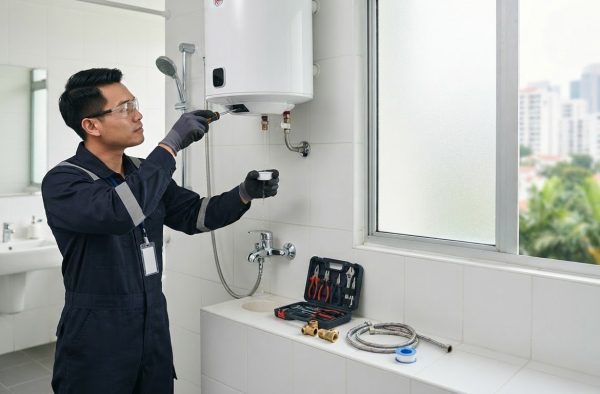
- Site Assessment and Isolation: Technicians inspect access clearances and switch off the main water and power feeds before starting any dismantling work.
- Draining and Disposal: The old tank is fully depressurized, drained of stagnant sediment, unbolted, and carefully removed through the access hatch.
- Structural Anchoring: Installers mount heavy-duty unistrut channels or masonry brackets directly into the concrete slab.
- Plumbing and Electrical Connections: Brass dielectric unions prevent galvanic corrosion between differing metals. The incoming cold line, non-return check valve, and hot supply lines are sealed tight.
- Tank Priming: Technicians fill the cylinder completely with water to expel trapped air before energizing the electrical circuit, preventing dry-burn element damage.
Post-Installation Commissioning and Homeowner Handover
Once connected, your installer performs thorough operational checks. The plumbing system is held under full mains pressure for a dedicated observation window to catch any weeping joints. Technicians test the double-pole isolator switch, measure electrical draw, and ensure the thermostat cycles off when target temperatures are reached. Before wrapping up, they explain optimal dial calibration to help balance hot water availability against daily power consumption.
Choosing a Dependable Installation Partner
A storage heater requires simultaneous expertise in sanitary plumbing and residential high-voltage circuits. Choosing an experienced team ensures all pipe runs remain neat, structural mountings stay rigid, and ceiling panels emerge undamaged. For seamless service handled by seasoned trade specialists, contact Sar Deen Engineering to manage your upcoming storage water heater installation Singapore project with complete confidence.
Upgrade Your Home’s Hot Water System With Confidence
Finding the right water heater comes down to balancing your household’s daily routines with your bathroom’s physical limits. Matching tank capacity to your specific shower fixtures prevents cold surprises without driving up power consumption. Verifying ceiling clearances, non-return valves, and dedicated electrical isolators safeguards your property against hidden water damage and circuit trips.
A lasting setup demands trade precision across sanitary plumbing, structural mounting, and electrical wiring. When you are ready for a reliable storage water heater installation Singapore homeowners count on, partner with trade specialists who prioritize safety and spotless workmanship. Schedule your professional water heater installation with Sar Deen Engineering to guarantee careful ceiling handling, dependable bracket anchoring, and thorough pressure testing. Step into warm, steady showers knowing your system was built to last.
Frequently Asked Questions
How long does a typical storage water heater installation take in Singapore?
A standard direct replacement usually takes between one to two hours to complete. Complex setups involving tight false ceiling access panels, pipe modifications, or new bracket mounting into concrete slabs can extend the work to three hours. The duration covers isolating water and electrical feeds, draining the old cylinder, securing the new unit, and performing mandatory pressure and leak checks.
Can a storage water heater fit inside a concealed bathroom false ceiling?
Yes, most horizontal storage water heaters are engineered specifically to fit inside false ceiling cavities. However, you must verify vertical clearance between the concrete slab and ceiling framework, alongside an accessible inspection hatch. Planning your storage water heater installation Singapore setup around proper hatch dimensions ensures technicians can maneuver the tank without cutting through finished plasterboards.
How do I know if my existing storage water heater needs replacement?
Rusty, discolored hot water, pooling moisture beneath the casing, and frequent breaker trips indicate that your tank needs replacement. If your cylinder takes noticeably longer to heat up or depletes its hot water reserve within minutes, mineral sludge has likely insulated the element. Most storage units provide reliable service for eight to ten years before internal corrosion compromises the vessel.
Is an electrical double-pole switch legally required for a storage heater?
Yes, Singapore electrical safety regulations require a dedicated 20A double-pole isolator switch equipped with an illuminated neon indicator. This switch completely severs both the live and neutral connections when switched off, protecting homeowners and technicians from electrical shock during servicing. The switch must always sit outside the bathroom or wet zones to prevent moisture exposure.
What happens if a storage water heater is turned on without water inside?
Turning on the power while the tank is empty causes dry firing, which burns out the heating element within seconds. Electric elements rely on surrounding water to absorb extreme heat. Without water, the metal element rapidly overheats, blisters, and snaps, requiring an immediate component replacement. Installers always purge air and fill the tank completely before energizing the circuit.
Can one storage water heater supply hot water to two separate bathrooms?
Yes, multi-point distribution is a primary advantage of installing a central storage heater. High-pressure distribution pipes can route hot water to the master ensuite, common bathroom, and kitchen sink simultaneously from a single tank. Sizing your system at 40 to 50 litres ensures both bathrooms receive stable temperature and steady water pressure during simultaneous morning routines.
How often should a residential storage water heater be serviced or flushed?
Flushing your storage cylinder once every two to three years helps remove accumulated mineral sediment. Routine draining clears calcium flakes settled at the bottom of the tank, allowing the heating element to operate efficiently while preventing foul water odors. Technicians can also check the sacrificial anode rod and manually test the pressure relief valve to verify overall system safety.