Tile Cracked Repair Singapore: Myths, Causes, and Expert Solutions
That sudden fracture across your floor didn’t happen because someone dropped a heavy mug. It happened because the concrete slab beneath it shifted. When you hear a sharp pop and spot a fissure spreading across the floor, it’s easy to assume the worst. If you are searching for reliable tile cracked repair Singapore homeowners can trust, you are likely wondering whether you can fix just one section or if you must hack up your entire home.
Nobody wants to endure the choking dust, deafening noise, and disruption of clearing out whole rooms. It’s frustrating to watch temporary fillers crumble away within weeks, leaving you worried that loose pieces will shatter underfoot. Fortunately, you don’t always need extensive re-screeding to restore peace of mind. In this guide, you will discover the real structural causes behind hollow tiles and learn how modern methods like targeted spot repair and chemical injection solve the root issue permanently. We will preview the proven solutions that keep your living space safe, clean, and intact.
Key Takeaways
- Discover why underlying slab movement breaks floor tiles, proving that fissures are structural symptoms rather than surface defects.
- Learn why DIY putties and topical fillers quickly fail against ongoing subfloor shifts.
- Find out how targeted tile cracked repair Singapore specialists use can restore your floor without the mess of hacking entire rooms.
- Explore how professional acoustic mapping locates hidden hollow voids before tiles pop up or shatter.
- Understand the vital role flexible perimeter joints play in stopping future cracks from returning.
Common Myths About What Causes Cracked Tiles in Singapore Homes
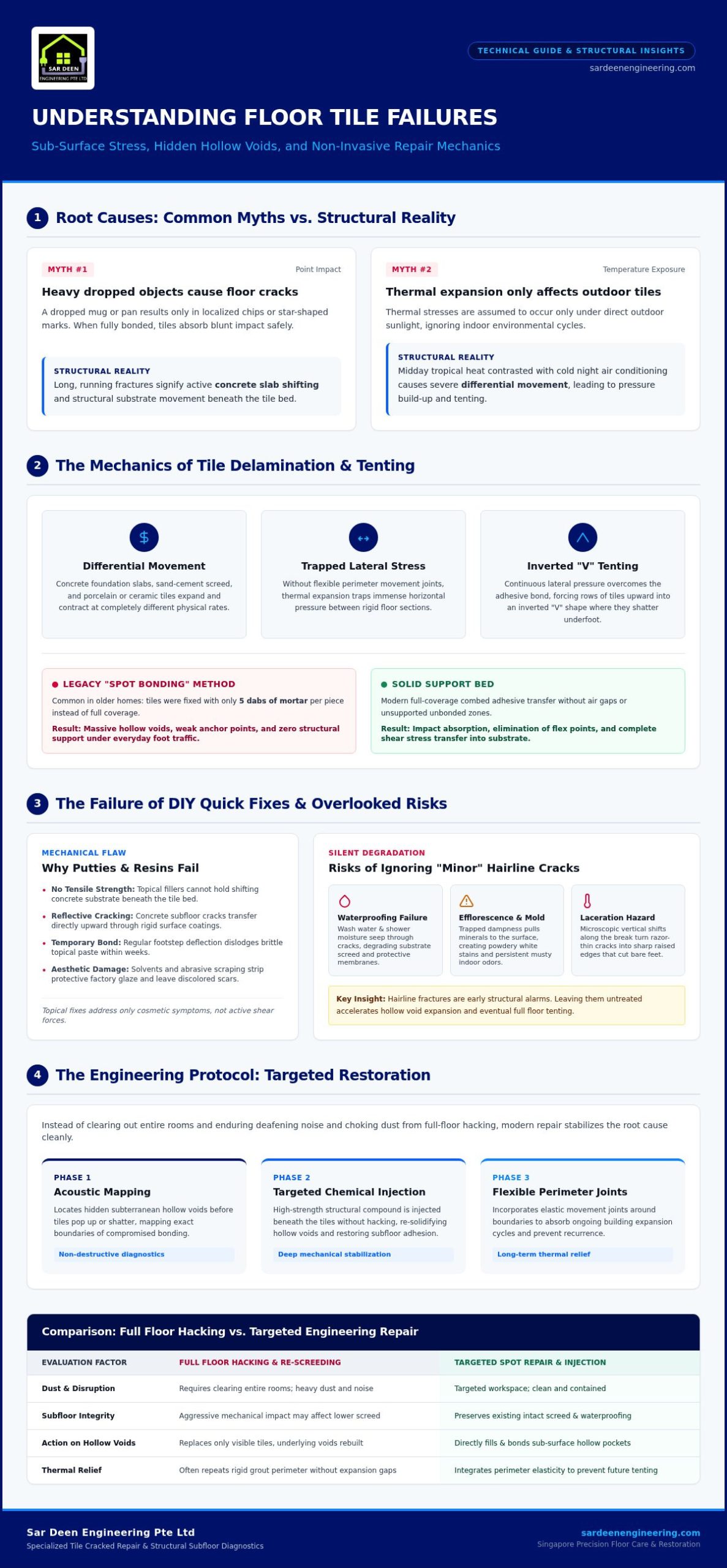
Most homeowners assume a fractured floor means someone dropped something heavy. In reality, a surface fracture is almost always a visible symptom of sub-surface shear stress. Premium materials are not immune either. High-density porcelain or standard ceramic tile will split just as readily when the foundation moves. When seeking reliable tile cracked repair Singapore residents often discover that substrate shrinkage, building settlement, and hollow voids are the true culprits behind their damaged floors.
Myth 1: Heavy Objects Dropping Are the Sole Cause of Tile Cracks
An impact from a dropped pan leaves a localized chip or star-shaped mark. It does not create long, running fractures across multiple pieces. When fully bonded with solid adhesive, tiles absorb blunt force without splitting apart. Cracks form when hollow pockets develop underneath. Without solid screed to support everyday foot traffic, ordinary steps flex the tile until it snaps.
Myth 2: Thermal Expansion Only Happens Outdoors Under Direct Sunlight
Indoor living spaces face extreme temperature swings every day. The tropical heat during midday contrasts sharply with powerful evening air conditioning. This daily cycle triggers constant expansion and contraction:
- Differential movement: Concrete slabs, sand-cement screed, and tiles expand and contract at completely different rates.
- Trapped pressure: Without elastic movement joints, tiles push against one another with immense force.
- Tenting: Trapped lateral pressure eventually forces rows of tiles to lift off the subfloor and shatter in an inverted “V” shape.
The True Culprit: Subfloor Debonding and Inadequate Adhesive Transfer
Poor installation methods accelerate this failure. Older homes frequently feature “spot bonding,” where workers applied five dabs of mortar per piece instead of a full, combed bed. Over time, vibration and ambient humidity weaken these isolated anchor points. In bathrooms, trapped moisture penetrates degraded grout joints, gradually disintegrating legacy mortar underneath. The tile loses its bond, shifts against adjacent pieces, and breaks along the unbonded hollow zone.
Proper tile service and precision tile repair resolve these issues before widespread tenting occurs. Understanding these hidden forces helps you tackle the foundation beneath rather than blaming everyday foot traffic.
Debunking Quick-Fix DIY Tile Repairs: Why Fillers and Glue Fail
When a crack appears, reaching for an over-the-counter repair kit or colored silicone feels like the easiest fix. Online marketplaces are filled with cheap putties promising invisible touch-ups. Unfortunately, smoothing resin over a broken surface ignores the active mechanical forces moving beneath your floor. When you need lasting tile cracked repair Singapore homes require deep mechanical stabilization rather than a cosmetic cover-up.
Myth 3: Topical Grout Filler Restores the Tile to Its Original Strength
Surface pastes lack tensile strength. According to industry analyses on the causes of reflective cracking, cracks in concrete transfer directly upward through rigid surface layers. When you smear filler into a crack, you aren’t fixing the bond beneath the tile. Daily foot traffic easily forces the paste loose, reopening the gap within weeks. DIY resins also stain surrounding pores, creating discolored scars that are difficult to scrub away.
Myth 4: A Hairline Crack Is Merely Cosmetic and Can Be Safely Ignored
Leaving a hairline break untouched introduces silent moisture hazards, especially in wet spaces. Water seeps into the substrate during daily floor washing or showers, triggering serious indoor issues:
- Waterproofing failure: Standing water migrates beneath bathroom membranes, slowly degrading structural screed beds.
- Efflorescence and mold: Trapped dampness draws minerals to the surface, creating powdery white stains and persistent musty odors.
- Laceration risks: Sub-surface movement causes microscopic vertical shifts, turning hair-thin cracks into razor-sharp edges that cut bare feet.
Harsh DIY solvents and improper scraping tools often strip the surrounding protective glaze, turning a small defect into an expensive eyesore. If you notice hollow echoes or widening fissures, getting a professional evaluation from Sar Deen Engineering Pte Ltd helps pinpoint the structural cause before loose tiles pop up.
Spot Tile Replacement vs. Full Floor Hacking: Choosing the Right Solution
Discovering a fractured tile often sparks panic. Many property owners worry that repairing one damaged piece requires tearing up an entire living hall or toilet. Fortunately, that assumption is false. Modern, precision tile cracked repair Singapore services allow technicians to isolate and replace single damaged units without disturbing stable surrounding areas.
| Factor | Spot Tile Repair | Full Floor Hacking |
|---|---|---|
| Dust & Debris | Minimal; localized shroud extraction catches fine grit | Severe; heavy airborne dust blankets the entire flat |
| Noise Levels | Low to moderate; precision rotary cutting | Extremely high; continuous demolition hammers |
| Turnaround Time | Usually completed within a single day | Several days to weeks including curing periods |
| Substrate Impact | Preserves existing screed and intact adjacent bonds | Completely strips screed down to the bare structural slab |
Myth 5: You Must Always Hack the Entire Floor When One Tile Breaks
Total demolition is rarely the only path forward. Skilled technicians score and clear perimeter grout lines first. This isolates mechanical vibrations and stops shockwaves from cracking adjacent tiles. If you kept extra pieces from your initial renovation turnover, matching the pattern is simple. When spare stock isn’t available, inserting complementary stone-look borders or clean accent tiles provides a neat, intentional design finish.
When Isolated Spot Repair Is Sufficient
Targeted tile service in Singapore works best when damage remains localized. A simple coin-tap test quickly reveals whether surrounding pieces are firmly anchored. If neighboring tiles produce a dull, solid click, your screed remains secure. Spot replacement removes the fractured piece, levels the sub-base, and beds a fresh tile in flexible polymer adhesive. This protects your daily routine from noisy demolition drills.
When Full Floor Re-screeding and Retiling Becomes Mandatory
Extensive structural failures call for complete intervention. When hollow echoes ring across multiple continuous square meters, adhesive debonding has spread too far for spot fixes. If tiles tent upward into steep ridges, trapped lateral stress has loosened entire floor sections. Persistent water seepage that rots the underlying mortar bed also demands total screed removal to reinstate proper waterproofing.
The Step-by-Step Professional Tile Cracked Repair Process
Restoring a fractured floor requires an orderly engineering sequence. Smashing a damaged piece with a hammer risks sending shockwaves into neighboring sections, turning a single broken tile into multiple loose ones. Professional execution contains the work area, limits indoor dust, and rebuilds the foundation correctly. For dependable tile cracked repair Singapore homeowners rely on structured multi-step restoration to guarantee lasting results.
Step 1: Acoustic Diagnostic Mapping and Perimeter Isolation
Technicians begin by systematically tapping the floor around the fracture with specialized diagnostic rods. This maps the exact boundary where the mortar bed remains bonded versus where hollow delamination has begun. Next, an oscillating tool equipped with a diamond-grit blade rakes out the surrounding grout lines down to the screed. Removing this joint relieves lateral stress and isolates mechanical vibrations, keeping adjacent tile edges safe from chipping.
Step 2: Controlled Core Removal and Bedding Reconstruction
Once isolated, the tile is gently fractured from the center outward using targeted low-impact chisels. Technicians never pry aggressively against adjacent tile rims. After lifting the broken fragments, the real work begins underneath:
- Mortar grinding: Specialized dust-shrouded grinders remove crumbling legacy mortar down to sound concrete.
- Substrate vacuuming: High-efficiency vacuum extractors clear away fine dust that would otherwise weaken fresh bonding agents.
- Foundation priming: The clean slab receives a bonding primer to prevent dry screed from pulling moisture out of the fresh adhesive.
Step 3: Polymer Adhesive Application, Tile Setting, and Final Grouting
A high-performance, polymer-modified thin-set mortar is applied with a notched trowel, creating uniform ridges that ensure complete surface contact without hollow pockets. The replacement piece is pressed firmly into place. Technicians install mechanical leveling clips across all four edges, ensuring the new surface sits perfectly flat with zero lippage. Flexible grout seals the joint margins, and the area is left undisturbed for a complete 24-hour cure before taking foot traffic.
When you want to resolve hollow or fractured floors without the mess of major hacking, book a professional tile repair service with experienced maintenance specialists who prioritize clean, precise workmanship.
Preventing Recurrent Tile Failures: Maintenance and Long-Term Protection
Fixing a broken tile removes an immediate safety hazard, but preventative maintenance keeps the surrounding floor secure for years. Guarding residential flooring against tropical humidity and building settlement requires practical structural buffers. When planning durable tile cracked repair Singapore homeowners should always verify that their floor assemblies have room to flex and protection from hidden water leaks.
The Critical Need for Perimeter Expansion Gaps
Flooring substrates expand and contract every day. If tiles meet skirting boards or boundary walls without a buffer, trapped lateral energy builds up quickly. Filling these perimeter margins with stiff cement grout locks the floor into an unyielding grid. As the concrete slab shifts or heats up during humid afternoons, compressive stress transfers into the tiles. Sealing perimeter joints with high-grade flexible silicone creates an elastic expansion cushion that absorbs movement and stops tiles from buckling.
Sealing Wet Areas with Resilient Epoxy Grout Systems
Traditional cementitious grout is naturally porous. In bathrooms and wash areas, standing water slowly seeps through grout lines and saturates the screed underneath. This persistent moisture breaks down legacy adhesives and triggers hollow debonding. Upgrading to waterproof epoxy grouting Singapore specialists recommend creates a solid, non-porous shield across your entire floor. Consider these ongoing protection habits:
- Routine inspections: Check high-traffic shower joints every few months for receding lines or pinholes.
- Prompt resealing: Address minor grout degradation immediately to stop water from rotting the adhesive bed.
- Climate balance: Avoid extreme thermostat drops directly after heavy steam showers to limit thermal shock.
Engaging Dedicated Residential Maintenance Professionals
Tackling early floor warnings saves you from dealing with sudden, loud popping tiles later. If you hear hollow echoes when walking across your home, take action before fractures spread to adjacent rows. Skilled technicians isolate failing sections quickly, restoring floor integrity with clean, tidy workmanship that respects your daily schedule. Contact Sar Deen Engineering for reliable tile repair, proactive tile service, and comprehensive home maintenance solutions that protect your living space.
Protect Your Home with Smarter Floor Restoration
Cracked tiles don’t mean your home needs weeks of noisy, destructive demolition. Recognizing that fractures stem from subfloor expansion, thermal shifts, and hollow debonding helps you solve the root problem instead of applying temporary cosmetic patches. Targeted spot replacement and flexible joint buffers stabilize your floor while sparing your household from airborne dust and prolonged disruption. When tackling tile cracked repair Singapore homeowners can restore their interiors cleanly and effectively.
Taking action at the very first hollow sound keeps your family safe from sharp edges and hidden water damage. With all-in-one expertise spanning structural tile service, plumbing, and epoxy grouting, our comprehensive residential maintenance team delivers lasting stability. We use clean, dust-controlled methods designed to safeguard your living space and preserve adjacent surfaces intact. Restore your floors safely with expert tile repair from Sar Deen Engineering and enjoy reliable comfort in your home once again.
Frequently Asked Questions
Can a cracked floor tile be repaired without removing it?
Yes, minor surface fissures can sometimes be stabilized using chemical injection, but full fractures usually require replacement. While specialized low-viscosity resins can flow into hollow cavities through drilled grout holes, they cannot fuse a severed tile back together seamlessly. For true long-term stability and safety, isolated tile replacement remains the standard method. It eliminates sharp edges completely and ensures fresh adhesive bonds the new piece securely to the subfloor.
Why do tiles in Singapore homes suddenly pop up or buckle?
Tiles pop up because trapped lateral pressure overcomes the adhesive bond beneath them. Singapore’s extreme humidity combined with indoor air conditioning causes rapid thermal expansion and contraction cycles. If the original installer didn’t leave flexible expansion joints along room perimeters, the expanding tiles push against each other. Eventually, this compressive force forces the tiles upward off the screed, producing an abrupt popping sound and forming an inverted tent shape.
How do I know if my tiles are hollow before they crack?
You can detect hollow areas by performing an acoustic tap test across your floor. Use a solid coin, a broom handle, or an inspection rod to lightly tap each tile. A solidly bonded tile emits a dull, low-pitched thud. A debonded tile produces a distinct, high-pitched, echoing hollow click. Mapping these hollow zones early allows you to address failing screed bonds before everyday foot traffic snaps the unsupported surface.
Is it possible to find matching tiles for an older residential unit?
Sourcing exact factory duplicates for older tiles is challenging because production batches change often. However, homeowners often have spare tiles stored in storerooms from past renovations. If spares aren’t available, specialists can source modern tiles with nearly identical tones and dimensions. Alternatively, installing a complementary feature tile creates an intentional design accent that blends naturally with the existing floor pattern without requiring a full room overhaul.
What happens if water seeps beneath a cracked bathroom floor tile?
Moisture seeping past a cracked bathroom tile slowly rots the underlying mortar bed and damages structural waterproofing membranes. Water pools in screed voids, encouraging hidden black mold growth and emitting persistent sour odors. Over time, this trapped moisture can cause ceiling leaks in the unit below. Investing in timely tile cracked repair Singapore services paired with waterproof epoxy grouting prevents costly structural damage to wet areas.
How long does a professional spot tile repair take to cure?
Most spot tile repairs require 24 hours of curing time before taking normal foot traffic. While high-performance polymer mortars set quickly enough for technicians to apply grout within several hours, the underlying bed needs a full day to reach maximum load-bearing strength. Keeping the area dry and avoiding heavy impacts during this curing window ensures the fresh adhesive establishes a permanent, rock-solid bond with the concrete foundation.
Can air conditioning cause floor tiles to crack unexpectedly?
Yes, drastic temperature swings from air conditioning frequently trigger tile fractures. When you chill a warm, humid room down to cool temperatures rapidly, tiles contract while the denser concrete subfloor cools at a much slower rate. This differential shrinkage exerts massive shear stress along the adhesive line. When seeking lasting tile cracked repair Singapore homeowners should maintain moderate indoor climate settings to minimize intense thermal shock on their flooring.