Tile Service in Singapore: What It Covers and When to Call a Professional
A cracked tile doesn’t always mean the whole floor needs replacing. Discoloured grout, a loose tile, and a spreading crack can point to different problems, so the right tile service depends on what you find. Before choosing a fix, check the surrounding area and note whether the issue seems to be changing.
It can be hard to tell whether you need tile repair, fresh grout, or replacement. Start by recording where the damage appears, how many tiles are affected, and whether you’ve noticed changes nearby. Clear photos and a short description can help you explain the problem when you arrange professional help.
This guide covers common tile and grout concerns, the differences between repair, epoxy grouting, and replacement, and what to check before contacting a professional. Sar Deen Engineering Pte Ltd lists tile repair and epoxy grouting among its residential services in Singapore, so you can ask whether either service suits the issue you’ve observed.
Key Takeaways
- A tile service may involve tile repair or grout work. The right scope depends on the visible issue and an assessment.
- Cracks, loose tiles, and stained grout can have different causes. Symptoms alone may not reveal what is happening underneath.
- Repair, regrouting, and replacement address different concerns. Compare the tile’s condition and the affected area before choosing an option.
- Before arranging help, photograph the problem, note any changes, and avoid disturbing loose tiles or applying unverified products.
- Ask about relevant experience, the proposed scope, and how the issue will be assessed. Sar Deen Engineering lists tile repair and epoxy grouting among its residential services in Singapore.
What Does a Tile Service Cover in a Singapore Home?
A tile service addresses problems with tiled surfaces, including tile repair or grout work. The exact scope depends on what’s visible and what an assessment finds. In an HDB flat or private residence, that may mean checking a cracked tile, loose flooring, or grout that has darkened over time. The first step is to identify the concern rather than assume every problem needs the same fix.
A tile service is professional help for assessing and addressing problems with tiles or the grout between them. Tiles may be ceramic or made from other materials; Ceramic tile offers an overview of one common tile type. The material, location, and condition can all affect which work may be suitable.
Which tile and grout problems may need attention?
Look for cracked or chipped tiles, tiles that appear loose, or areas that sound hollow when tapped. Grout may look stained, become discoloured, or appear worn or deteriorated. These are observations, not diagnoses. Dark grout may be an appearance concern, while loose tiles or changing cracks may point to movement or loss of adhesion. In a wet area, signs of moisture also deserve attention.
Similar symptoms can have different causes. A professional assessment can help distinguish a surface issue from a concern that may involve what sits beneath the tile. Don’t assume that cleaning or covering a mark will address the underlying problem.
What is usually included in a tile service?
The scope varies by provider and problem. It may include an inspection and targeted tile repair, but an assessment helps determine what work is appropriate. Regrouting means removing and renewing grout between tiles; it doesn’t replace the tiles themselves. Epoxy grouting is a separate service category from tile repair, so confirm the specific work involved with the provider.
Sar Deen Engineering Pte Ltd lists residential tile repair and epoxy grouting among its services in Singapore. These are distinct options for different surface concerns, and the suitable scope depends on the issue and assessment. Before proceeding, ask the provider to clarify:
- Which tiles or grout lines are included
- What work and preparation are covered
- Which materials are proposed
- Whether the assessment identifies concerns beyond the visible surface
Clear answers help you understand what’s being addressed and what remains outside the agreed scope. This matters especially when dark grout appears alongside cracked, loose, or deteriorating tiles.
Why Do Tiles Crack, Loosen, or Develop Stained Grout?
A crack or dark grout line is a clue, not a diagnosis. Impact, movement, installation or bonding problems, moisture exposure, and routine wear are all possible contributors. The same visible mark can have more than one explanation, and the surface alone may not show what is happening underneath.
A grout problem affects the material between tiles, while tile or substrate damage involves the tile itself or the surface beneath it. This distinction can help you describe what you see, but it doesn’t confirm the cause. The Tile Council of North America provides industry resources on tile installation and best practices. A professional assessment is still needed to understand a specific home’s conditions.
What can cause cracked or loose tiles?
A dropped object may chip or crack a tile. Movement in the surface beneath it, a weak bond, or an installation issue may also contribute to cracking or looseness. If several tiles are affected, or a crack appears to change over time, note the pattern and ask for an assessment. One cracked tile alone doesn’t prove widespread structural damage.
A hollow sound or slight movement may be worth mentioning, but avoid prying up a loose tile to investigate. Repeated movement or bonding concerns may involve more than the visible surface. An assessment can help clarify what needs attention without assuming the cause in advance.
Why does grout discolour, crack, or turn dark?
Dark grout may reflect surface dirt or staining, but persistent dampness or deteriorating grout may also affect its appearance. In Singapore’s humid conditions, ventilation and moisture exposure are useful details to observe, especially in a shower that stays damp or has limited airflow. These factors can influence what you see, but they don’t establish why a particular grout line has turned black.
Cleaning habits may affect staining, while cracked, crumbling, or missing grout is a different concern from simple discolouration. Note whether dark areas return after cleaning, whether grout feels damaged, and whether nearby tiles are loose or cracked. Don’t assume that new grout will address the issue based on appearance alone.
For more detail on grout options, read the complete epoxy grouting guide. Sar Deen Engineering lists epoxy grouting and tile repair among its residential services. If the cause isn’t clear, share what you’ve observed and ask whether an assessment is appropriate before deciding on work.
Tile Repair, Regrouting, or Replacement: How Do the Options Differ?
These options address different parts of a tiled surface. Regrouting focuses on the joints between tiles. Tile repair concerns the tile itself or its condition. Replacement may be considered when a tile can’t be suitably repaired. A provider can assess the condition, the size of the affected area, and whether nearby tiles also show signs of a problem before recommending work.
| Option | Problem it may address | Limit to consider |
|---|---|---|
| Tile repair | An isolated chip, crack, or other tile concern to be assessed | Feasibility may depend on the damage, tile condition, and stability nearby |
| Regrouting | Worn, damaged, or discoloured grout when the tiles are sound | It renews grout, not the tiles, and may not address a separate tile or underlying issue |
| Replacement | A tile that can’t be suitably repaired, subject to assessment | Matching the existing tile and defining the affected area may be considerations |
When might targeted tile repair be considered?
An isolated chip or crack is a useful example to discuss with a provider, not a guarantee that repair is suitable. The tile’s condition, the visible damage, and the stability of the surrounding area can affect what’s practical. Matching the existing tile may also matter if the work involves a visible section.
Ask whether the assessment will include adjacent tiles, and describe any visible signs that may relate to the damage rather than focusing only on the mark. For more context, see this tile crack repair guide.
When might regrouting or tile replacement be considered?
If grout is the main concern and the tiles appear sound, regrouting may be an option to discuss. It addresses the joints, not cracks or looseness in the tiles. If a tile can’t be suitably repaired, replacement may be considered instead. The recommendation should reflect the condition and extent of the problem, not just the appearance of one grout line.
Before agreeing to work, ask why the option is recommended and confirm which tiles or grout lines are included, what preparation is involved, and where the work stops. Sar Deen Engineering lists tile repair and epoxy grouting among its residential services in Singapore. Confirm the specific scope with the provider, since the right choice depends on assessment.
How Can You Assess a Tile Problem Before Booking a Service?
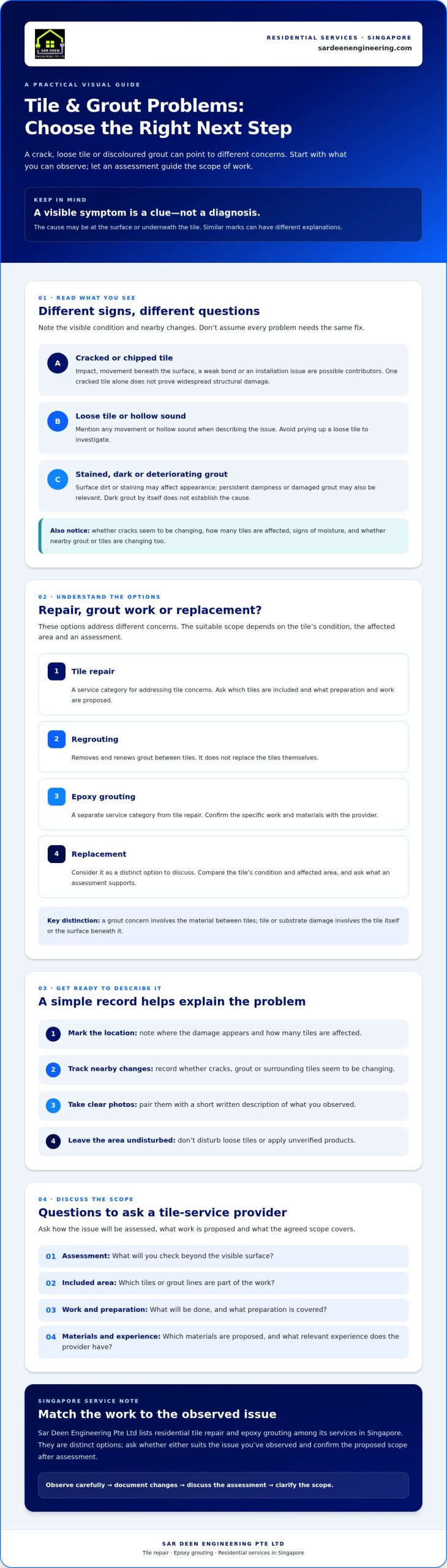
A few careful observations can help you explain the issue clearly without trying to diagnose it yourself. Look at the affected tiles and grout, take photos if it’s safe, and note whether anything has changed. Don’t pry up a loose tile or apply unverified chemicals or adhesives. These steps could disturb the area or make it harder to understand the original problem.
What should you check and record?
Start with the room and approximate size of the affected area. Describe what you see, such as a dark grout line, a crack, a chip, or a tile that appears loose. Note whether the symptom is spreading, returning after cleaning, or staying the same.
If you can do so safely, take one close photograph and another from farther away to show the wider area. Include relevant context, such as a recent impact, a change in cleaning habits, or recurring moisture. Before contacting a provider, record the room, affected area, visible symptom, changes over time, and any relevant impact, cleaning change, or moisture.
Recurring dampness, spreading cracks, or several loose tiles are reasons to seek professional advice rather than assume the issue is limited to the visible mark. These signs don’t confirm an underlying cause, but they give a provider useful context for deciding what to assess.
What should you ask before work begins?
Ask what the assessment covers and which options may suit the condition you’ve described. Clarify whether the proposed work concerns tile repair, grout, or both. If grout is the main concern, ask what grout work is included. If tiles appear loose or damaged, ask how they will be assessed.
- Which tiles and grout lines are included?
- What preparation and cleanup are part of the agreed work?
- How will the provider explain unexpected findings?
- Will you be consulted before any change to the agreed scope?
Clear answers help you understand the boundaries of a tile service before work starts. Sar Deen Engineering lists residential tile repair and epoxy grouting in Singapore. If you’ve recorded the symptoms and want to discuss a tile repair concern, contact Sar Deen Engineering about tile repair.
Choosing a Tile Service in Singapore: What Should You Expect?
A useful conversation about tile service should leave you clearer about the problem, the proposed work, and its limits. Don’t rely on a broad label alone. Check whether the provider handles your concern, such as tile repair or grout work, and whether they’re willing to assess the affected area before suggesting an approach.
How can you evaluate a tile-service provider?
Look for relevant tile experience and clear communication about what can and can’t be confirmed from the information available. A provider should be able to explain what the assessment involves, what work they’re proposing, and why it may suit the visible issue. If dark shower grout is the main concern, clarify whether the discussion is about grout or whether nearby tile condition also needs attention.
Compare written scopes where possible. Check that each one identifies the affected area, the work included, and any stated limitations. Two providers may use similar service labels but describe different work. A clear scope makes those differences easier to understand before you decide.
What happens after you make an enquiry?
Share a concise description of the problem and any clear photographs you’ve taken. Mention where the issue is and whether it has changed. This gives the provider useful context, but it may not be enough to confirm the cause or the right approach. They may need to assess the actual conditions before outlining suitable work.
Sar Deen Engineering Pte Ltd lists residential tile repair and epoxy grouting among its home maintenance services in Singapore. These are distinct service categories, so confirm directly whether the company’s current scope suits your specific concern. Ask what the assessment covers, what work is proposed, and how any limitations will be explained before proceeding.
A careful conversation helps set practical expectations without assuming that every dark grout line needs the same treatment. When comparing options, focus on clarity, relevant service scope, and how openly the provider answers your questions.
To review the company’s broader listed offerings, explore Sar Deen Engineering’s home maintenance services.
Take the Next Step With Clear Information
The right tile service starts with understanding what the visible problem may involve. Grout concerns and damaged tiles can call for different work, so an assessment helps clarify which option may be suitable. Before arranging help, record what you see and ask what the proposed work includes.
Sar Deen Engineering lists tile repair and epoxy grouting among its residential services in Singapore. These are separate service categories, and you can confirm directly whether either fits your concern and what the work would cover.
Contact Sar Deen Engineering to discuss your tile concern and review its listed home maintenance services. Clear observations and questions can help you make a more informed decision about your tiles.
Frequently Asked Questions
What does a tile service include?
A tile service may cover assessment and work related to tiles or grout, but the exact scope varies by provider and problem. Sar Deen Engineering Pte Ltd lists residential tile repair and epoxy grouting among its services in Singapore. These are different service categories, so ask whether the provider handles your specific concern and what the proposed work includes before proceeding.
How do I know if a cracked tile needs professional repair?
Ask for professional advice if a crack is spreading, appears alongside loose tiles, or keeps returning after a previous repair. A single chip after an impact may be limited, but appearance alone can’t confirm the cause or what lies beneath the tile. Photograph the crack, note whether it changes, and describe any nearby damage when arranging an assessment.
Can I replace or repair a tile myself?
You may be able to handle a simple surface-cleaning task yourself, but tile repair or replacement can be harder to judge without knowing whether surrounding tiles are stable. Avoid prying up loose tiles or applying unverified adhesives or chemicals. If the tile is cracked, moving, or near recurring moisture, ask a professional to assess the condition and explain suitable options.
What is the difference between tile repair and regrouting?
Tile repair addresses a concern with the tile, while regrouting renews the material in the joints between tiles. Regrouting doesn’t replace or repair a cracked tile. If the grout is worn but the tiles appear sound, ask whether grout work may be appropriate. If tiles are loose or damaged, clarify whether they also need assessment.
Why is the grout between my tiles turning black?
Black or dark grout may be caused by surface dirt, staining, persistent dampness, or deteriorating grout. In a shower, moisture exposure and limited ventilation can affect how grout looks, but colour alone can’t identify the cause. Notice whether the marks return after cleaning or appear alongside damaged grout or loose tiles, and share those details when seeking advice.
Should I repair a loose tile or replace it?
It depends on the tile’s condition, the affected area, and what an assessment finds. A loose tile may need attention beyond its visible edge, while a damaged tile that can’t be suitably repaired may lead to a replacement discussion. Don’t assume either option is right before checking the surrounding tiles. Ask the provider to explain the recommendation and work boundaries.
What should I tell a tile service provider when I enquire?
Describe the room, the approximate affected area, and what you’ve observed, such as black grout, a crack, or a loose tile. Say whether the issue is changing and mention relevant context, including recurring moisture or a recent impact. Share clear photographs if available. Ask what the assessment covers, which work may be suitable, and what the proposed scope includes.